
How to Maintain a Social Life While Smashing Your Academic Goals

University life is a whirlwind. It is an exciting chapter filled with rigorous coursework, late-night study sessions, and the pressure to achieve stellar grades. However, it is also a time for making lifelong friends, exploring new interests, and developing essential social skills that will serve you for decades. The challenge for many undergraduate students across the globe—from London to Sydney to New York—is finding that elusive “sweet spot” where academic excellence and a fulfilling social life coexist. Striking this balance is not just about fun; it is crucial for your mental well-being, your networking potential, and your overall university experience.
You might be feeling the immense pressure of constantly juggling deadlines, perhaps wondering if it is even possible to have both a high GPA and a social calendar. The good news is that it absolutely is. It requires conscious effort, effective time management, and a bit of strategic thinking. For many students, especially when coursework becomes overwhelming during midterm season, seeking external support like reliable assignment help from experts at MyAssignmentHelp can be a smart, strategic move. This doesn’t mean bypassing the learning process or taking a shortcut; it means managing your workload intelligently so you can dedicate time to other essential aspects of life, like social connection, physical health, or much-needed rest. By utilizing such resources, you can free up valuable mental space and reduce the “noise” of a cluttered schedule, ensuring your grades remain high while you still have the energy for those Friday night plans with your cohort.
The Science of the “Social Break”
Many students fall into the trap of “productivity guilt”—the feeling that every hour not spent in the library is a wasted hour. However, cognitive science suggests the opposite. The human brain is not designed for twelve hours of continuous, high-level focus. After a certain point, the law of diminishing returns sets in: you spend four hours reading the same page because your brain is fatigued.
Socializing acts as a “reset button.” Engaging in a conversation that isn’t about your syllabus triggers different neural pathways, allowing your academic focus to recover. When you return to your desk after a genuine social interaction, you are often more efficient, meaning you can accomplish in two hours what would have taken four hours of exhausted “pseudo-studying.”
Strategy 1: The Art of Time Blocking
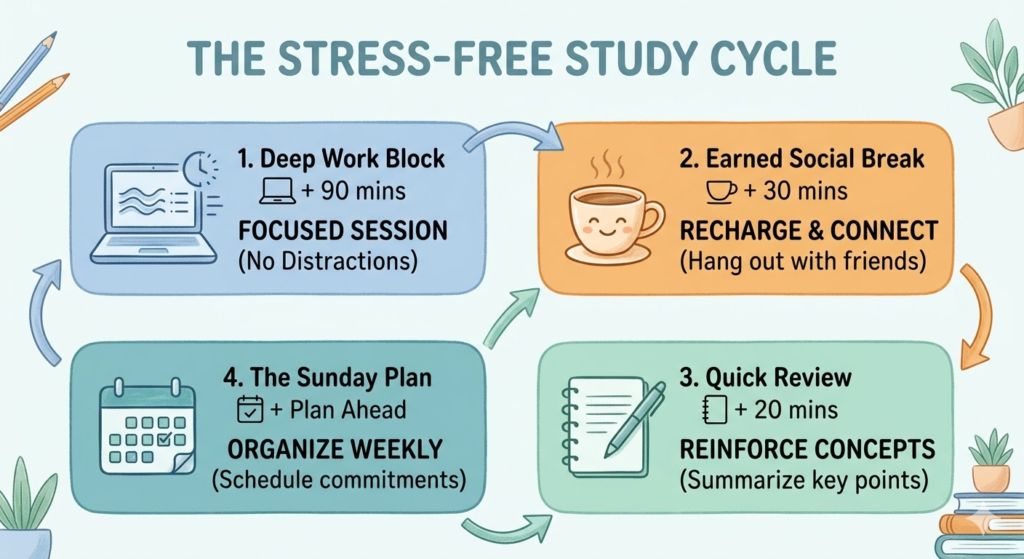
The foundation of balance lies in how you manage your hours. Instead of a vague to-do list that feels like a mountain, try “Time Blocking.” This involves carving out specific, immutable chunks of your day for dedicated tasks.
- The Academic Deep Work Block: Focus on your hardest subjects when your energy is highest (e.g., 9:00 AM – 12:00 PM). Turn off your phone and stay off social media.
- The Social “Non-Negotiable” Block: Treat a dinner date, a club meeting, or a gym session with friends as a “non-negotiable” appointment. If it’s in the calendar, you are less likely to cancel it out of guilt.
- The Buffer Zone: Always leave 30 to 45 minutes of “unstructured” time between tasks. This accounts for over-running lectures or spontaneous chats in the hallway, preventing your whole day from collapsing if one thing runs late.
Strategy 2: High-Efficiency Study Techniques
To spend less time at a desk and more time out with friends, you need to study at a higher intensity. The Pomodoro Technique (25 minutes of work, 5 minutes of rest) is a classic for a reason—it keeps the brain sharp and prevents the “marathon” fatigue.
Furthermore, the complexity of modern degrees often means you hit a “wall” in specific subjects. For those tackling specialized technical modules or advanced calculus, seeking expert mathematics assignment help through MyAssignmentHelp can bridge the gap between abstract theories and practical application. Getting this targeted assistance in the middle of a heavy semester ensures you don’t spend forty hours stuck on a single equation or proof, allowing you to stay on track with both your syllabus and your social calendar. It is about identifying where your time is best spent and where a little expert guidance can save you dozens of hours of frustration.
Comparison: Passive vs. Active Balancing
| Feature | Passive Approach (Stressed) | Active Approach (Balanced) |
| Planning | Reactive (doing things as they arrive) | Proactive (scheduling weeks in advance) |
| Social Life | Last-minute and guilt-ridden | Planned, guilt-free, and refreshing |
| Study Style | Long, distracted hours of “scrolling” | Short, intense “Deep Work” sessions |
| Support | Trying to do everything alone | Using resources like MyAssignmentHelp |
| Outcome | Burnout and average grades | Sustained energy and academic success |
Strategy 3: Quality Over Quantity in Relationships
In the social media age, there is a pressure to be “everywhere” and know “everyone.” For a student aiming for high goals, this is impossible. Instead, focus on quality.
A one-hour meaningful conversation with a close friend who supports your ambitions is often more rejuvenating than four hours of “hanging out” in a noisy room where you aren’t really connecting. Identify the people in your life who respect your study boundaries and prioritize spending your limited social energy with them. These are the friends who will understand when you say you need to stay in on a Tuesday, and who will be the first to celebrate with you when your results come in.
Strategy 4: Learning the “Soft Decline”
You cannot attend every party, join every society, and still ace every exam. Part of the global undergraduate experience is learning the art of the “soft decline.” This is a way to protect your time without burning social bridges.
Instead of a flat “I can’t go,” which can feel cold, try a “conditional” decline:
- “I’m hitting a major deadline tonight, but I’d love to catch up over coffee on Thursday afternoon instead.”
- “I have to pass on the movie tonight to prep for a seminar, but definitely keep me in the loop for the next one!”
This approach signals that you value the relationship while making it clear that your academic goals are a priority.
Strategy 5: Integrating Socializing into Academics
Who says studying has to be lonely? Some of the best academic progress happens in “Study Groups”—provided they are structured correctly.
Find two or three peers who are as driven as you are. Set a specific goal for the session (e.g., “We will finish the draft for Module 3”). Work in silence for 50 minutes, then take a 10-minute break to chat and grab a snack. This allows you to feel the presence of your friends and enjoy social interaction without letting your productivity slip. It turns the library from a place of “isolation” into a place of “community.”
Conclusion: The Long-Term View
Finding balance during your undergraduate years is about more than just surviving the next three years. It is about developing a sustainable lifestyle. In the professional world, the people who thrive are rarely the ones who work 20 hours a day until they burn out. They are the ones who know how to manage their energy, delegate when necessary, and maintain a support network that keeps them grounded.
Frequently Asked Questions (FAQ)
1. Is it bad to ask for help with my assignments from a service?
Ans: Not at all. Professional academic support is a tool used by many top-performing students worldwide. It is about gaining clarity on complex topics and managing a high-volume workload effectively. Using a service like MyAssignmentHelp allows you to see how a professional approaches a topic, which can actually improve your own writing and analytical skills over time.
2. How do I stop feeling guilty when I’m not studying?
Ans: Guilt usually stems from a lack of a clear plan. If you have scheduled your study time and met your specific goals for that block, your social time is “earned.” When you treat your social life as a scheduled part of your health and well-being, the guilt begins to fade.
3. What if my friends have much easier courses than I do?
Ans: This is a common challenge. You must be honest with them. Real friends will respect your ambition. Explain that while you’d love to hang out as much as they do, your course requires a different level of commitment. Most people will admire your discipline.
4. How do I recover if I’ve already fallen behind in my social life?
Ans: Start small. Don’t try to go to three parties in one weekend. Reach out to one friend for a walk or a quick lunch. Rebuilding your social life is just like catching up on a module—take it one step at a time.
5. Can I really rank at the top of my class and still have fun?
Ans: Absolutely. Many “First Class” students are those who know how to switch off. The ability to relax is what gives you the stamina to work hard when it matters. It’s about being 100% present in whatever you are doing at that moment—whether that’s solving a complex math problem or laughing with friends.
About The Author
Hi, I’m Ruby Walker. I am a senior academic consultant and lead content strategist at MyAssignmentHelp, where I’ve spent the last several years helping students navigate the high-pressure world of modern higher education. My mission is to bridge the gap between complex academic requirements and student well-being.